How AI Changed the Way We Use Our Design Tools
Artificial intelligence has become one of the biggest talking points in the creative industry. Depending on who you ask, it’s either replacing creative professionals or revolutionising the way they work.
At TIRON, our experience has been much simpler than either of those extremes.
AI hasn’t replaced our designers, developers, or strategists. Instead, it has changed how we use our design tools. The biggest difference isn’t that we’re creating more work. It’s that we’re spending less time on repetitive production tasks and more time solving meaningful design problems for our clients.
Like every major technological shift before it, AI has become another tool in our workflow. The real value doesn’t come from using AI itself. It comes from knowing when to use it, when not to use it, and how to combine it with human creativity and critical thinking.
Before AI: The Hidden Work Behind Every Creative Project
Every successful project has always involved far more than what clients eventually see.
Long before a website launches or a brand campaign goes live, creative teams spend countless hours on tasks that, while necessary, don’t necessarily require creative thinking.
A few years ago, creating a motion graphics project often meant relying on external voiceover services and waiting for revisions. Removing a subject from a photo in Photoshop could take several minutes of careful masking. Finding the right stock image sometimes meant searching through hundreds of photos, hoping one matched the exact angle, lighting, composition, or perspective needed.
If an image was too narrow for a banner or too tall for a website layout, we often had to search for an entirely different asset or manually extend the background.
These tasks were part of the job, but they rarely added creative value. They consumed time that could have been spent refining ideas, improving user experiences, or exploring stronger visual directions.
After AI: Less Production, More Problem Solving
Today’s AI-powered design tools have dramatically reduced the amount of manual production work involved in creative projects.
Instead of spending hours on repetitive edits, our team can focus on making better creative decisions.
Background removal that once required careful manual selection now takes seconds. Images can be intelligently expanded to fit different layouts without restarting the asset search. When stock photography falls short, AI-generated imagery can help create visuals that closely match the creative direction we’re aiming for.
This shift has fundamentally changed how we work.
Rather than replacing creativity, AI removes many of the repetitive tasks that interrupt the creative process.
How AI Supports Each Team at TIRON
Graphic Design
Graphic designers have probably experienced some of the most noticeable workflow improvements.
Today, AI assists us with:
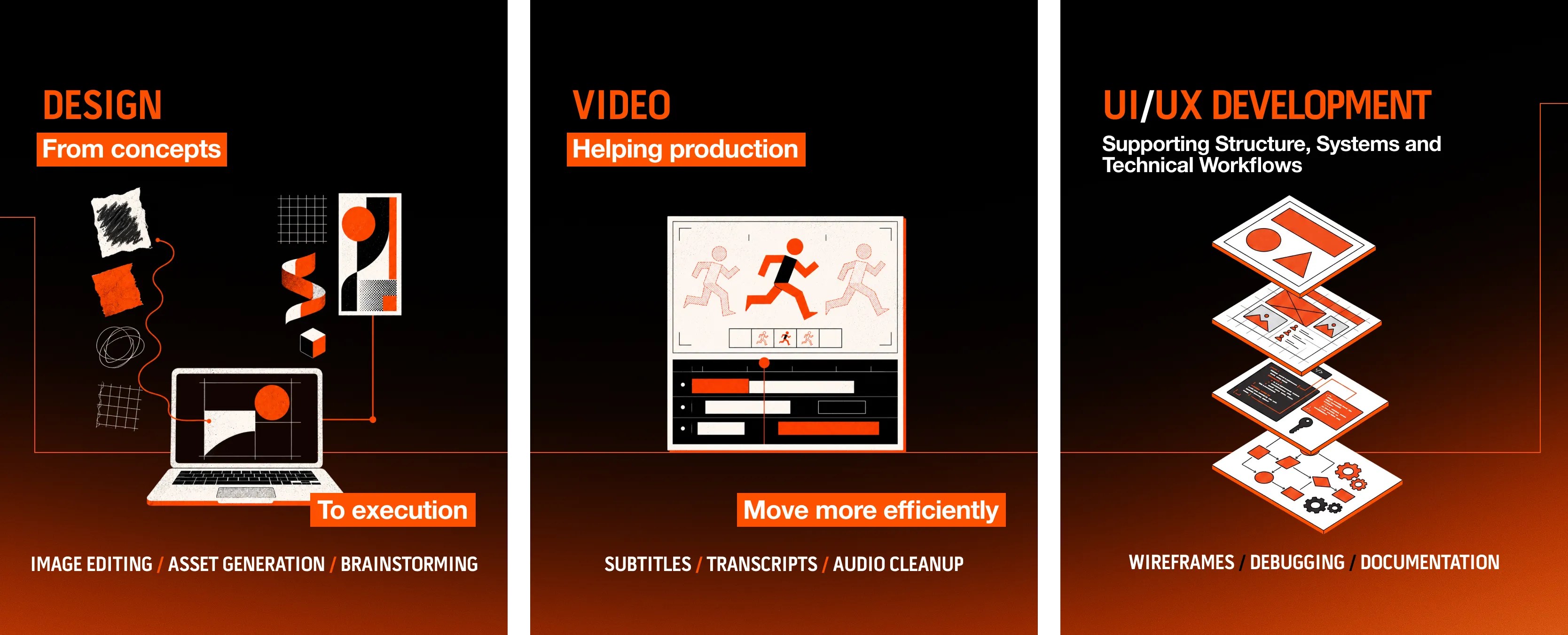
- Image editing and asset generation
- Background removal and object cleanup
- Mockup creation
- Image expansion for different aspect ratios
- Proofreading marketing materials
- Copywriting assistance for early drafts
- Brainstorming visual concepts and campaign ideas
- Generating placeholder imagery during concept development
Instead of spending hours preparing assets, designers can dedicate more time to composition, typography, storytelling, and creating stronger visual communication.
Video Production
Video editing has also become significantly more efficient.
AI helps streamline production through:
- AI-generated voiceovers during concept stages
- Background music suggestions
- Automatic subtitles and captions
- Transcript generation
- Audio cleanup and noise reduction
These improvements allow editors to spend more time refining pacing, animation, sound design, and storytelling instead of manually completing repetitive editing tasks.
UI/UX Design
In UI and UX design, speed matters, but consistency matters even more.
AI now helps us with:
- Automated sitemap generation
- Early-stage wireframing
- Organising and naming design layers
- Creating new pages based on existing design systems
- Maintaining visual consistency across interfaces
- Generating realistic placeholder content
- Accessibility reviews
- Design documentation
Rather than starting with a blank canvas every time, designers can begin with a structured foundation and spend more time solving usability challenges.
Web Development
For developers, AI acts more like a technical assistant than a replacement.
It supports tasks such as:
- Debugging code
- Explaining unfamiliar frameworks
- Building component scaffolding
- Generating boilerplate code
- Creating reusable UI components
- Producing documentation
- Suggesting performance improvements
- Accelerating repetitive frontend development
- Creating new pages using existing design systems
By reducing repetitive coding work, developers can focus on architecture, performance, security, scalability, and quality assurance.
The Benefits of Using AI Responsibly
When integrated thoughtfully into creative workflows, AI offers several advantages.
It helps reduce production time without sacrificing quality.
It accelerates brainstorming by allowing teams to explore multiple creative directions more quickly.
It improves quality control through proofreading, consistency checks, and code reviews.
It allows faster prototyping, helping clients visualise ideas earlier in the design process.
Most importantly, it frees creative professionals from repetitive production work so they can spend more time thinking strategically and solving real business problems.
The Challenges AI Still Brings
AI isn’t perfect, and treating it as a complete solution often leads to disappointing results.
One of the biggest misconceptions is that you can simply write a prompt and receive exactly what you need.
In reality, generating high-quality outputs usually requires multiple rounds of refinement. The better the creative direction, the better the result.
AI also tends to produce generic work when left unsupervised. Without experienced designers and developers guiding the process, outputs often lack originality, brand consistency, or strategic thinking.
There are also practical considerations.
Generated images may require extensive editing before they’re production-ready. AI can confidently produce incorrect information, especially when writing copy or generating code. Every output still requires human review to ensure accuracy, quality, and alignment with project goals.
In many ways, AI has shifted the work rather than eliminated it. Less time is spent creating assets from scratch, but more time is invested in evaluating, refining, and directing AI-generated outputs.
What AI Still Can’t Replace
Despite its rapid progress, AI still struggles with the parts of design that matter most.
It can’t sit in a discovery workshop and uncover the real business challenge behind a project.
It can’t build trust with clients or understand the nuances of a brand’s personality.
It doesn’t recognise the emotional impact of a visual identity or understand why one user journey feels intuitive while another creates friction.
It can’t challenge assumptions, ask better questions, or balance business objectives with user needs.
These are the decisions that define successful creative work, and they continue to rely on human experience, empathy, and judgment.
Our Approach to AI at TIRON
At TIRON, we see AI as an amplifier, not a replacement.
We use it to remove the repetitive, time-consuming parts of the creative process so our designers, developers, and strategists can focus on what matters most: solving problems, refining ideas, and delivering thoughtful work that helps our clients succeed.
Every project still benefits from human creativity, professional judgment, and careful attention to detail. AI may help us move faster, but speed alone has never been our goal.
Our goal is to produce work that’s purposeful, polished, and built around real business outcomes.
Because great design has never been about how quickly something is made.
It’s about how well it solves the problem it was created to solve.
About Me
.png)