Building Software Is Not Just Coding
How to Manage a Software Product Successfully
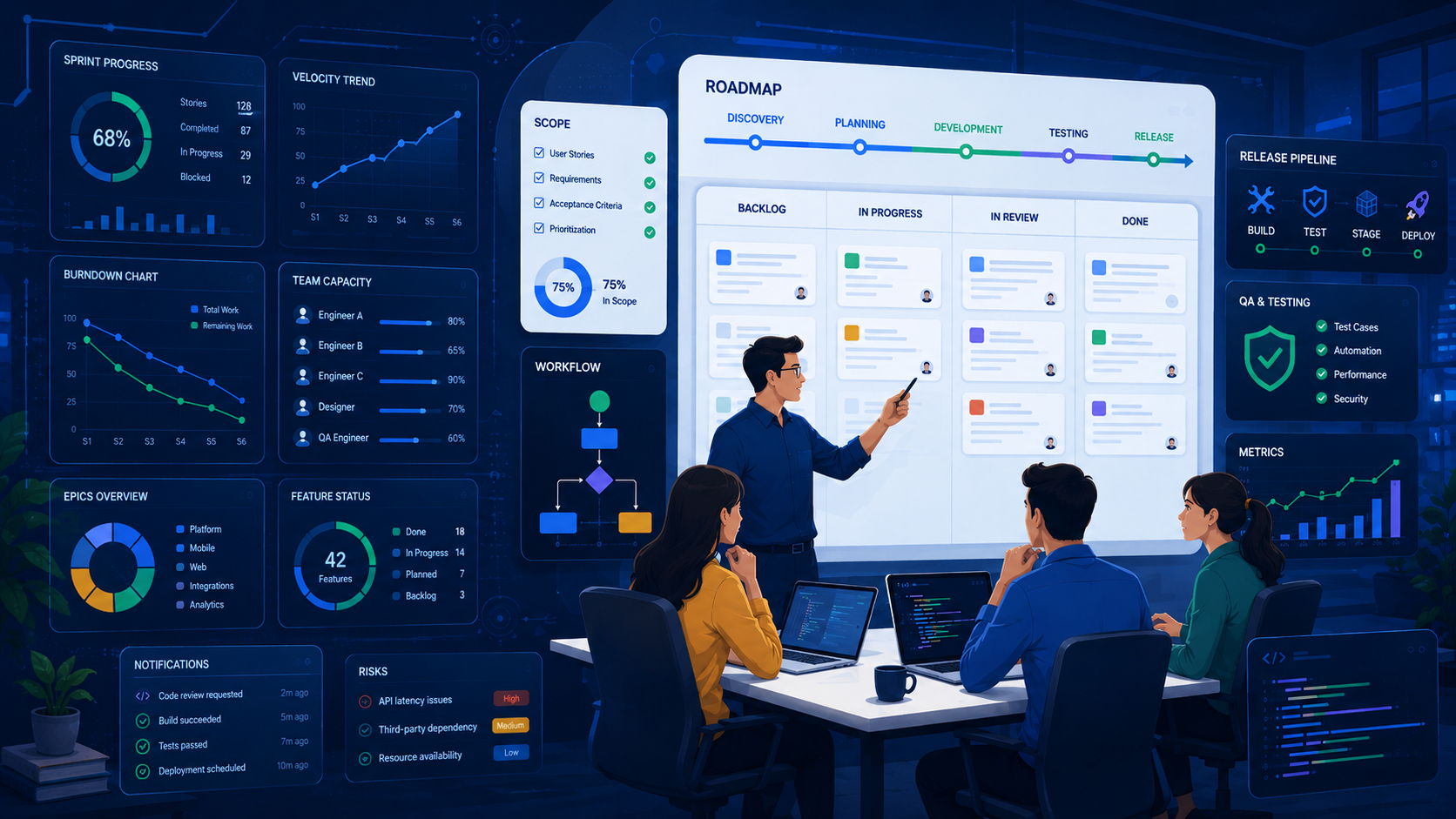
Building a successful software product is not only about writing code.
Many businesses start a software project with a clear goal: build a system, test it, launch it, and solve a business problem. But as the project grows, new ideas appear, requirements change, users ask for improvements, and the product becomes more complex than originally expected.
This is normal in software development.
However, without the right process, software projects can quickly become difficult to manage. Timelines become unclear. Features expand beyond the original . Testing becomes rushed. Stakeholders expect everything to be completed at once. Eventually, the product may take longer to release, cost more than expected, and create frustration for everyone involved.
That is why successful software delivery needs more than development skills. It needs proper software product management, clear ownership, agile planning, quality assurance, release management, and continuous communication.
Why Software Products Need a Different Mindset
A software product is not a one-time output that is completed and forgotten. It is a living system that supports business operations, user workflows, data, decisions, and ongoing improvements.
A single product may include user accounts, dashboards, permissions, reports, payments,notifications, integrations, approval flows, and business rules. Becauseeverything is connected, one small change in one area can affect another partof the system.
For example,changing how a user creates a record may also affect reports, permissions, notifications, audit logs, and approval processes. This interdependence isexactly why software requires careful planning, testing, and release management.
Another important point: users often understand their real needs more clearly after they start using the product. A feature that looks simple during planning mayreveal new edge cases during development or testing. A workflow that seems complete at the start may need adjustments after user feedback.
This does not mean the original plan was wrong. It means software development is naturally iterative. Successful.products are built through continuous learning, improvement, and collaboration. They need structure, but they also need flexibility.
Start With Clear Product Ownership
Every successful software product needs clear product ownership. Product ownership means one person is responsible for understanding the business goals, user needs, priorities, and expected outcomes of the product. This role keeps the team anchored to a set of questions:
- What problem are we solving?
- Who are we solving it for?
- Which features are most important?
- What should be built now, and what can be released later?
- How do we measure success?
Without clear product ownership, software projects become reactive. Every new idea feels urgent. Every request is treated as a must-have. Developers receive unclear requirements, and stakeholders hold different expectations.
A strong product owner brings clarity. They do not simply collect feature requests, they decide what should be built, why it matters, and when it should be delivered. They also protect the product from unnecessary complexity by keeping the focus on business value. Good product ownership ensures the team is not just building features, but building the right features.
Manage Scope Before It Becomes Scope Creep
Change is normal in software development, in fact, it is expected. As stakeholders see early versions, they discover new needs. Business teams identify better workflows. Users request improvements. Market conditions shift. The problem is not change itself. The problem is uncontrolled change.
What is scope creep? Scope creep is when new features, changes, or expectations are added to a project without properly reviewing their impact on timeline, budget, and quality. Individually the changes seem small; together they increase development effort, delay releases, reduce quality, and pressure the team.
Scope defines what is included in the project, what will be delivered, within what timeline, and under what budget. A professional software delivery process reviews every new request against a consistent set of factors:
- Business value
- Technical complexity
- Timeline impact
- Budget impact
- Risk
- Priority
- Effect on existing features
Not every new idea belongs in the current release; some are better planned for a future phase. This is not about rejecting ideas, it is about making better decisions together. A healthier response sounds like:
“Yes, we can consider this feature. Let’s review its impact on the timeline, cost, and current priorities before we commit.”
This approach creates transparency and protects the success of the product.
Agile Planning: Flexibility with Structure
Agile software development is often misunderstood. Some people think agile means changing everything at any time. Others think it means there is no planning. In reality, agile is not the absence of planning, agile is continuous planning based on learning.
In traditional project planning, teams try to define everything up front and deliver the full product at the end. That can work for predictable projects, but software is often uncertain: users may not know exactly what they need until they start using the product.
Agile solves this by delivering software in smaller stages. Instead of waiting months for a complete product, the team plans smaller releases, collects feedback, and improves step by step. A good agile process usually includes:
- A prioritised product backlog
- Sprint or iteration planning
- Regular progress reviews
- Clear acceptance criteria
- Frequent demos
- Structured feedback collection
- Continuous improvement
Agile give steams flexibility, but that flexibility must be managed. It should not become chaos, and it should not mean every request is added immediately. Good agile planning helps everyone understand what is being built now, what is coming next, and why certain decisions are being made.
Release Management: Why Gradual Releases Reduce Risk
Many businesses want to launch a perfect, complete product all at once. That is understandable, but in software development, waiting for perfection usually creates more risk.The larger the first release, the harder it becomes to test, validate, and improve.
A better approach is gradual release management: releasing the product in planned stages. Instead of building every possible feature before launch, the team ships the most valuable version first, often called an MVP (minimum viable product), pilot, beta, or phase-one release. The goal is not to release something poor or incomplete. The goal is to release something useful, focused, and testable.
Gradual releases help teams:
- Get real user feedback earlier
- Identify problems before they become expensive
- Reduce development risk
- Improve features based on actual usage
- Avoid building unnecessary functionality
- Deliver business value sooner
For example, instead of launching a large system with every possible feature, the first release might focus on the most important workflows. Later releases can add advaned reports, notifications, integrations, automation, and analytics. A perfect first release is rarely realistic, a well-planned first release is far more valuable.
Quality Assurance Is Not Optional as SoftwareGrows
Quality assurance (QA) is one of the most important parts of software delivery. In small projects, developers test their own work, and that is still necessary, developers should always confirm their work functions as expected. But as a product grows, developer testing alone is not enough.
Software products include different user roles, workflows, edge cases, devices, browsers, permissions, and data conditions. A developer mainly checks whether a feature works technically. A QA process checks whether the feature works correctly from a user and business perspective. Software QA helps validate:
- User flows
- Business rules
- Form validations
- Error handling
- Edge cases
- Permission rules
- Existing feature stability and regression issues
- Acceptance criteria
QA also supports sign-off. A feature is not complete just because the development work is finished, it should be tested, reviewed, and approved against agreed expectations. As software becomes more complex, QA gives confidence to the business, the users, and the development team.
Good QA does not slow down delivery, poor quality slows down delivery. When bugs are found late, they are more expensive and more stressful to fix. A proper QA process catches issues earlier and improves the overall reliability of the product.
Clear Acceptance Criteria Help Everyone Understand “Done”
One of the most common problems in software projects is unclear expectations. A stakeholder may say, “We need a customer management module.” But what does that actually mean? Does it include customer creation, editing, deleting, search, filters, attachments, activity history, permissions, exporting, importing, validation, and duplicate detection? Without clarity, different people imagine different outcomes.
Acceptance criteria define what must be true for a feature to be accepted. They help developers, QA, the product owner, and stakeholders agree on expected behaviour before development begins. For a customer-creation feature, acceptance criteria might include:
- The user can create a customer with the requireddetails.
- The system validates required fields.
- Duplicate email addresses are not allowed.
- The user receives a success message after creation.
- The new customer appears in the customer list.
- Unauthorised users cannot create customers.
This level of clarity reduces confusion and helps developers build correctly, QA test accurately, and stakeholders approve confidently. A clear definition of done may include requirements clarification, design review, development completion, code review, developer testing, QA testing, acceptance-criteria validation, sign-off, and release to the correct environment, creating a professional delivery process that reduces rework.
Communication Keeps Everyone Aligned
Many software delivery problems are not caused by technical difficulty, they are caused by unclear communication. A successful product needs regular communication between stakeholders, product owners, developers, QA teams, designers, and business decision-makers. Good communication answers questions such as:
- What are we building now?
- What has changed?
- What is blocked?
- What needs approval?
- What is ready for testing?
- What is planned for the next release?
- What risks should be discussed?
Useful practices include regular status updates, sprint planning meetings, backlog review sessions, product demos, release notes, change-request documentation, decision logs, QA reports, and sign-off records. Communication does not need to be complicated, it needs to be clear, consistent, and useful. When communication is strong, everyone understands the current state of the product, which reduces assumptions and builds trust.
There Is No Such Thing as Completely Bug-Free Software
Every serious software product must accept one truth: no software is completely bug-free forever. Even the best software companies in the world release updates, patches, improvements, and bug fixes. Software runs in changing environments, browsers update, devices change, user behaviour shifts, business rules evolve, third-party services change, and new features affect old ones.
The goal of software delivery is not to promise that bugs will never happen. The goal is to reduce risk, test important flows, monitor the product, respond quickly, and continuously improve. A mature software team focuses on preventing critical issues, testing core workflows, fixing bugs by priority, learning from production issues, and making the product more stable over time.
Good software is not perfect on day one. Good software is carefully built, tested, released, monitored, and improved over time.
Frequently asked questions
What is software productmanagement?
Softwareproduct management is the practice of planning, prioritising, building, testing, and releasing a software product so it delivers real business value.Itcombines product ownership, agile planning, scope control, quality assurance, and release management, going well beyond writing code.
Why is building software morethan just coding?
Software is a living system of connected parts, user roles, data, workflows, permissions, and integrations, that keeps changing after launch. Coding produces features, but ownership, planning, testing, communication, and release management are what turn those features into a reliable, valuable product.
What is scope creep and how doyou prevent it?
Scope creep is the uncontrolled addition of features or changes without reviewing their impact on timeline, budget, and quality. You prevent it by defining clearscope and reviewing every new request against business value, complexity, risk, priority, and effect on existing features before committing.
Does agile mean there is noplanning?
No. Agile is not the absence of planning, it is continuous planning based on learning.Instead of defining everything up front, agile teams deliver software in small stages, collect feedback, and refine priorities, using a backlog, sprin planning, acceptance criteria, and regular reviews.
What is an MVP in softwaredevelopment?
An MVP (minimum viable product) is the smallest useful, focused, and testable version of a product that delivers real value. Releasing an MVP first reduces risk, surfaces genuine user feedback early, and avoids building unnecessary features before they are validated.
Why is quality assurance (QA)important?
QA checks whether a feature works correctly from a user and business perspective, not just technically. It validates user flows, business rules, edge cases, permissions, and regressions. Good QA catches issues early, when they are cheaper and easier to fix, and gives stakeholders confidence to sign off.
What are acceptance criteriaand a definition of done?
Acceptance criteria define what must be true for a single feature to be accepted. A definition of done is the broader checklist a piece of work must meet before release, typically requirements clarity, design review, development, codereview, QA testing, acceptance validation, sign-off, and deployment.
Can software ever be completelybug-free?
No software is copletely bug-free forever, because it runs in constantly changing environments. Mature teams focus on reducing risk, testing core workflows, monitoring production, fixing issues by priority, and improving continuously, rather than promising perfection.
Building software is not just coding. A successful software product requires the right combination of strategy, planning, design, development, testing, communication, and continuous improvement. Because software products contain business workflows, user roles, data, integrations, and changing requirements, they need proper product ownership, agile delivery, scope control, QA, and release management.
The best software products are n ot built by trying to do everything at once. They are built by focusing on the right priorities, releasing in stages, learning from feedback, and improving continuously.
For businesses planning to build custom software development, the most important decision is not only choosing a development team, it is choosing a team that understands how to manage software delivery properly. Because in the end, successful software is not just about what gets built. It is about how well it is planned, delivered, tested, released, and improved over time.
Planing a software product?
Tiron Agency helps businesses design and build digital products that are managed end to end — from strategy and UX to development and release. Talk to our team or explore our website design & development services.
About Me