Motion as a Branding Tool
Why Static Websites Are Losing Impact in 2026
Motion as a branding tool uses purposeful animation, page transitions, scroll-triggered reveals, and micro-interactions to communicate brand personality, hold attention, and drive recall. In 2026, static websites no longer differentiate. Brands using GSAP, Webflow Interactions, Barba.js, and smooth scroll libraries like Lenis are building experiences that static design simply cannot compete with.
Why staticwebsites are losing their edge
To be clear, static design is not inherently inferior. Many of the most elegant websites ever made have been still. The issue is one of context and expectation. Users in 2026 are navigating a web increasingly defined by fluid interfaces from app-like SaaS products to the kinetic editorial design of the best-funded brand campaigns.Against that backdrop, a wholly static website now reads as passive, even tentative.
Research from Microsoft Canada (2015) documented the shift toward faster content-processing bursts in digital consumers. In the decade since, social platforms have accelerated this further. Average feed scroll rates have increased consistently year-on-year. Motion interrupts the scroll reflex at a pre-cognitive level, it is processed by the human perceptual system before conscious attention is engaged. A static page asks users to stop and look. A motion-led page stops them before they decide to.
There is also a commercial signal at play. Brands investing in considered motion design communicate, implicitly but unmistakably, that they think carefully about experience. In competitive markets agencies,D2C brands, technology companies this signal is often the first and most durable impression a potential client or customer forms. Static websites, in this context, are not simply missing an opportunity. They are actively telling a story about the brand's ambition.
The technical toolkit: GSAP, Webflow, Barba.js, and smooth scroll
Effective motion branding in 2026 is built on a small stack of interconnected tools. Each solves a distinct layer of the problem. Understanding what they do and how they work together is the starting point for building a motion system that performs as well as it looks.
GSAP
GreenSock Animation Platform, or GSAP, is the industry standard JavaScript animation library for production web work. It runs at 60fps across all major browsers, performs consistently on mobile, and integrates cleanly with Webflow, React, and vanilla JavaScript projects alike.
Its timeline model sequences tweens that can be staggered, reversed, and nested. This maps directly to brand motion choreography: entrance sequences, scroll driven reveals, and page transition states all become legible, iterable code.
The ScrollTrigger plugin is where most brand work lives. ScrollTrigger binds animation progress to scroll position, enabling pinned sections, parallax layers, and counter animations triggered by viewport entry without the performance cost of JavaScript scroll listeners.
The Flip plugin handles layout transitions fluidly. MorphSVG and DrawSVG power brand illustration animation: logos that draw themselves in, icons that transform between states, and typographic elements that build on screen.
The performance discipline is simple but non negotiable: animate only CSS transform and opacity, the two properties browsers hand off to the GPU without triggering a layout recalculation. Everything else causes dropped frames.
Webflow
Webflow’s Interactions 2.0 system brings a visual timeline editor to motion design. It allows drag and drop trigger definition, keyframe animation, and scroll progress binding without requiring JavaScript knowledge.
For marketing sites and brand campaigns, this means designers can author scroll triggered storytelling and hover state choreography directly in the design tool, then ship to production without a handoff step.
The platform’s CMS integration extends motion to dynamic content: case study cards, blog grids, and team pages all support staggered reveals applied at the component level, rendering consistently across every CMS driven page.
Webflow’s Lottie integration allows After Effects animations exported as lightweight JSON files to be bound to scroll progress or click triggers, bringing motion graphics quality animation to the browser at a fraction of video file weight.
For brands building motion forward marketing sites, Webflow is the fastest path from design intent to shipped product.
Barba Js
The single largest gap in standard web motion experiences is the page transition. Most sites, including Webflow sites without custom code, reload pages with a hard cut. Barba.js solves this by intercepting link clicks, prefetching the next page, and executing a custom transition between the outgoing and incoming views. The result is a single page application feel within a traditional multi page site architecture.
For brand work, Barba.js transitions become a motion signature: a colour wipe in a brand accent, a clip path reveal from the centre of the screen, or a logo morph between pages. Every navigation event becomes an opportunity to reinforce personality. Combined with GSAP timelines through Barba’s hooks API, the transition layer becomes precise, performant, and on brand.A well built transition system can run in roughly 60 to 80 lines of JavaScript. It is the motion equivalent of commissioning a custom typeface: one decision that changes the temperature of the entire brand experience and is seen by every user who navigates the site.
Smoothscroll: Lenis and Locomotive
Native browser scroll is functional but characterless. Smooth scroll libraries replace the browser’s default scroll behaviour with physics based interpolation that gives the page a weighted, intentional feel, as if the content has mass and momentum rather than jumping instantly to cursor position. This is the layer most users cannot identify explicitly but immediately register as polish.
Lenis is lightweight and integrates cleanly with GSAP, making it ideal for most builds. Locomotive offers deeper visual effects like parallax but requires more setup. Both should respect reduced motion settings for accessibility.
Motion is not about impressing users. It is about removing the friction between their attention and your message. When done well, it accelerates comprehension, builds trust, and makes the experience feel authored rather than assembled.
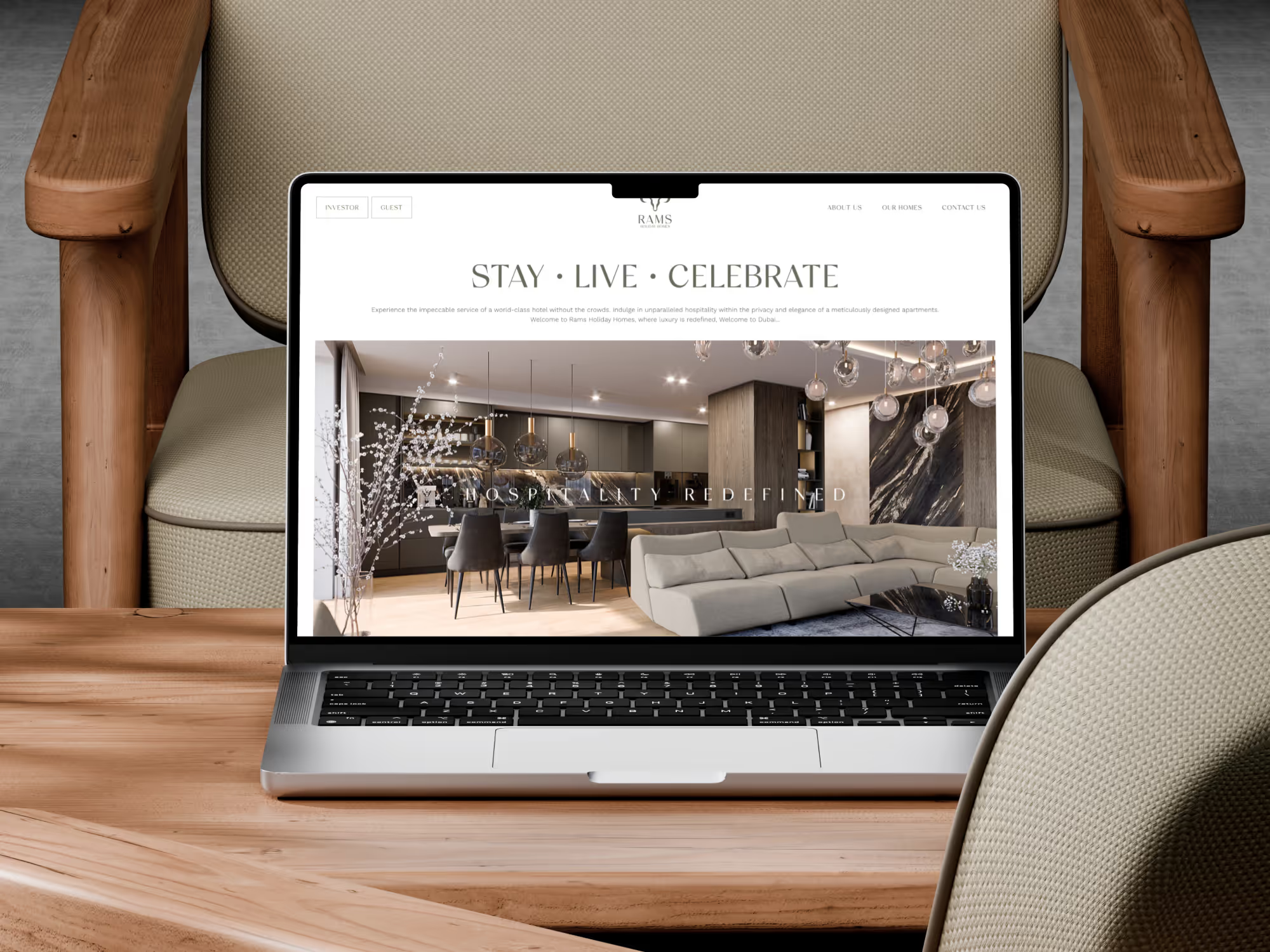
Rams Homes (ramshomes.com) uses Webflow with GSAP ScrollTrigger, SplitText, and CustomEase. The motion system is intentionally measured easing curves and duration scales tuned to feel premium and unhurried, matching the tone of the real estate brand withoutintroducing complexity that would undermine confidence.
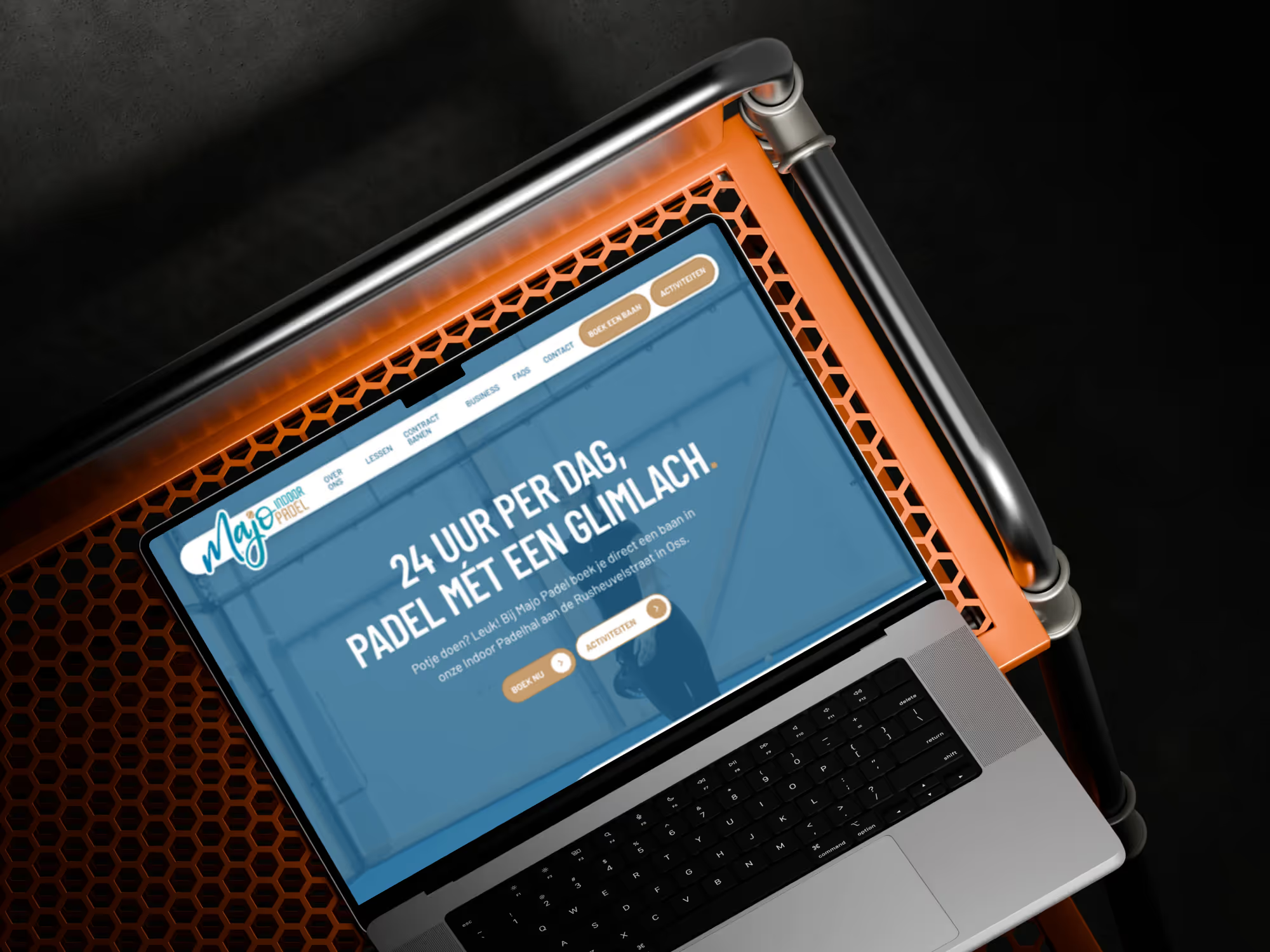
Majo Padel (majopadel.com) pairs Webflow and Lenis smooth scroll with GSAP ScrollTrigger, SplitText, and CustomEase. The smoothscroll configuration gives the site a physical weight appropriate to the branda sports and lifestyle context where energy and momentum are part of the identity.
Building a motion language, not a motion library
The part brands most often get wrong is the distinction between motion as expression and motion as noise. Effective brand motion is not a collection of animations, it is a system. One primary easing curve. One duration scale, with fast at 200ms, medium at 400ms, and slow at 800ms as a workable starting point. One stagger interval for grouped elements. These three decisions, written into a motion guidelines document before any code is written, turn individual animations into a coherent brand signal.
Choreography should always follow hierarchy. Decide the reading order, headline, subhead, body, CTA, before defining a single animation. Motion should guide the eye through that order in sequence, not compete with it. A hero sequence can feel kinetic and almost overwhelming on the surface. Underneath should sit a single GSAP timeline with three or four staggered tweens, completing in under 900ms. The spectacle lives at the surface. The legibility lives in the structure. This is harder to achieve than a static layout. Every animated element must earn its place against the hierarchy and the performance budget, but it is what separates brand motion from visual noise.
80%
7 sec
48%
References
Accio. (2025). Gen Z maximalism trend: How 2025 fashionbreaks minimalist rules. https://www.accio.com/business/gen_z_maximalism_trend
Colorcom. (n.d.). Why colour matters. https://www.colorcom.com/research/why-color-matters
GreenSock. (2024). GSAP documentation. https://gsap.com/docs/v3/
Meggs, P. B., & Purvis, A. W. (2016). Meggs' historyof graphic design (6th ed.). Wiley.
Microsoft Canada. (2015). Attention spans: Consumerinsights. https://dl.motamem.org/microsoft-attention-spans-research-report.pdf
Wyzowl. (2024). State of video marketing 2024. https://www.wyzowl.com/video-marketing-statistics/
Common pitfalls of motion branding
Animation for its own sake is the most common failure mode. Adding motion without a hierarchy rationale produces noise, not brand. Every animated element should be justifiable: it directs attention, reinforces reading order, or encodes personality. If it does none of these, it should not be there. Animating layout triggering properties, such as width, height, padding, and margin, forces the browser to recalculate layout on every frame. The result is dropped frames and janky motion that damages brand perception rather than enhancing it. Animate only transform and opacity.
Page transitions lasting longer than 700ms become interruptions rather than brand moments. Err toward brevity: a 400ms transition done well is invisible in the best sense. The user notices the experience, not the technology.
Finally, never ignore reduced motion preferences. The CSS media query prefers reduced motion exists because a significant proportion of users experience motion sickness or vestibular disorders triggered by animation. Every motion system, including smooth scroll, must include a reduced motion variant. GSAP, Webflow, Lenis, and Locomotive Scroll all support this natively. Accessibility is non negotiable for any brand serving public audiences.
About Me