The Lazy Brain Goes Shopping
What Cognitive Science Says About Buying in the Age of AI Agents
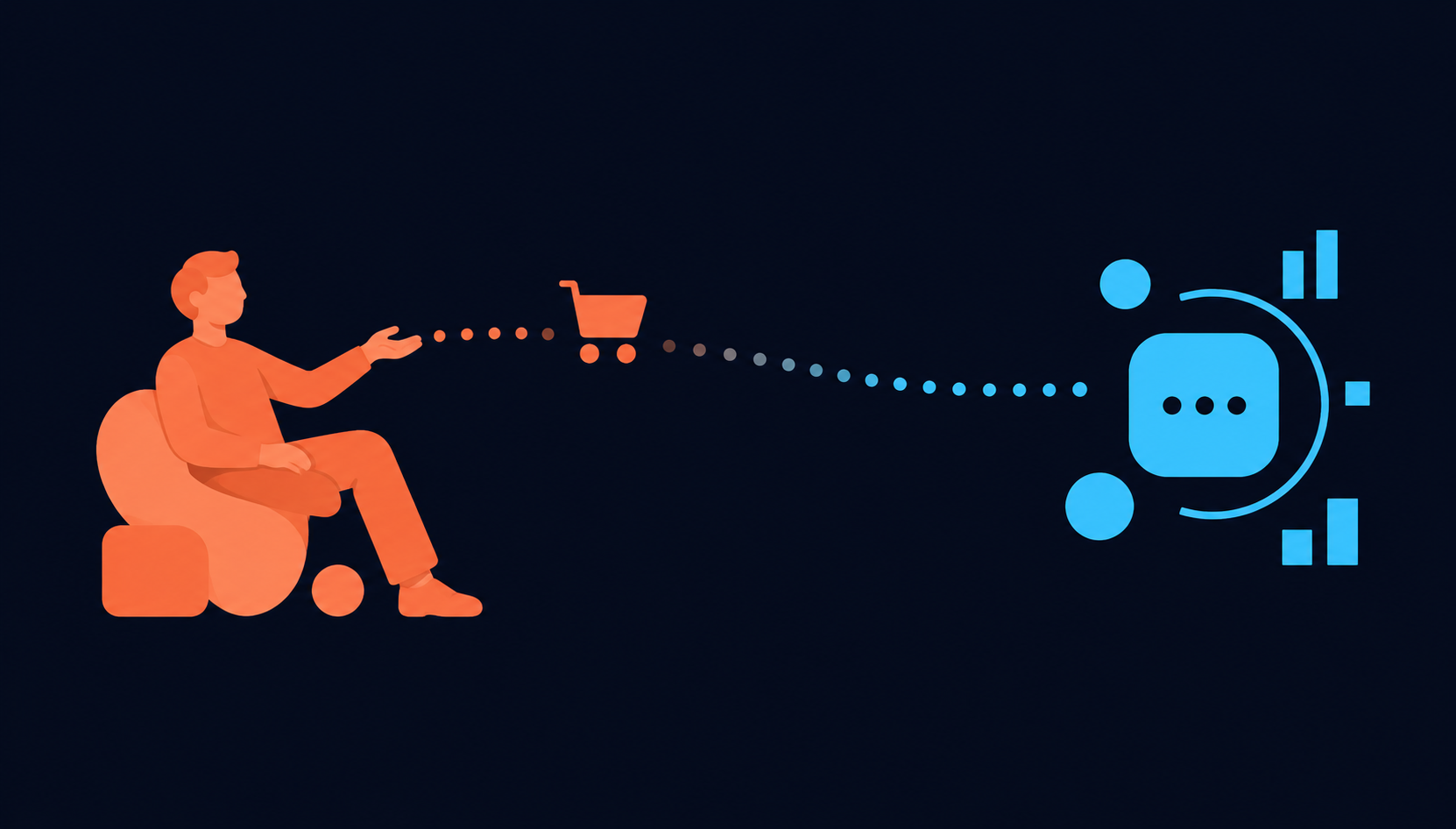
AI shopping agents are absorbing the effort of buying. The research suggests something surprising: once everything is easy, ease stops mattering, and desire becomes the whole game.
Key takeaways
- The brain is an effort-minimising machine. The "law of less work" governs most purchase behaviour.
- AI shopping agents are cognitive offloading at scale: they absorb the effortful discovery phase of buying.
- A 2026 study of 725 shoppers found laziness did not predict continued AI use; novelty seeking did. Ease has become table stakes.
- Agents introduce a second reader of your storefront. AEO and GEO are how you engineer cognitive ease for a machine.
- The winning brands will be machine-legible underneath and humanly desirable on the surface, both at once.
You think you decide what to buy. Mostly, you don't. Not consciously, anyway. By the time a product feels "right," your brain has already done the quiet work of steering you toward whichever option asked the least of it. We like to imagine purchasing as a careful weighing of options. The science says something less flattering and far more useful: the brain is an effort-minimising machine, and most of what we call "choice" is really the path of least resistance dressed up as a decision.
That instinct has a name.
The law of less work is the well-documented tendency to choose whichever course of action demands the least mental effort (Kool et al., 2010).
Some scholars go further and call it rational laziness: when time is short and options are abundant, leaning on automatic, low-effort thinking isn't a flaw, it's an adaptation (Birkelund, 2016). Hold that idea, because it's about to collide with the most significant shift in online retail since the shopping cart: the arrival of AI agents that don't just help us shop, but shop for us. And it's a shift that quietly rewrites the brief for everyone who designs storefronts. Which is to say, it's a shift we think about a lot.
When a machine takes over the thinking, the obvious question becomes the interesting one: if effort is no longer the cost of buying, what's left to compete on?
The lazy brain, explained
Start with why effort matters so much. Cognitive load theory holds that our working memory is small and easily swamped; push too much information through it and both the quality of decisions and our satisfaction with them degrade (Sweller, 1988). This is why a cluttered checkout, an ambiguous size chart, or one too many pop-ups doesn't just annoy people; it taxes a system that was never built for heavy lifting. It's also why so much of our UI/UX work is really an exercise in removing things rather than adding them.
The flip side of overload is cognitive ease: the pleasant sense of fluency we feel when something is easy to process. Kahneman (2011) showed that ease isn't a neutral state. When information flows smoothly, we trust it more, like it more, and feel more confident acting on it. Fluency feels like truth. In commerce, that translates almost directly into conversion.
Decades of technology research point the same way. The Technology Acceptance Model identified perceived ease of use as one of the strongest predictors of whether people adopt a new tool at all (Davis, 1989). Friction, in other words, isn't a cosmetic problem. It's a cognitive tax, and the brain is exceptionally good at routing around it.
AI agents as cognitive offloading
Seen through this lens, AI shopping agents aren't really "the future of retail." They're the logical endpoint of the lazy brain: a way to offload the most effortful parts of buying entirely. The agent runs the search, compares the options, filters out the noise, and hands you a shortlist or simply completes the purchase. Discovery, the part that used to consume the most working memory, is quietly absorbed by the machine.
And the more it works, the more we let it. Expectation-confirmation theory explains why: when a technology meets or beats our expectations, satisfaction rises, and satisfaction is the engine of continued use (Bhattacherjee, 2001). Every effortless interaction lowers the bar for the next one. This is how agentic shopping compounds: not through a single dramatic conversion, but through a slow erosion of the effort it takes to buy anything at all. It's most visible in recurring, low-friction categories first; the kind of subscription experience we built for The Daily Cup is exactly where an agent is happiest taking the wheel.
The twist: when everything is easy, ease stops mattering
Here's where the research gets genuinely surprising. A recent study of online shoppers (725 valid respondents, overwhelmingly Gen Z) set out to test whether human laziness would strengthen the link between a good AI experience and the intention to keep using it. The intuitive bet is yes: lazier shoppers should cling hardest to the tools that do the work for them.
It didn't hold. Laziness had no measurable moderating effect (Anggraeni et al., 2026). The authors' explanation is quietly profound: AI in e-commerce is already so effortless that ease has become table stakes. When everything is easy, being easy no longer sets you apart.
What did matter was the opposite impulse: novelty seeking, the appetite for new, stimulating, distinctive experiences (Hirschman, 1980; Anggraeni et al., 2026). The shoppers who kept coming back weren't chasing the least effort; they were chasing something that felt fresh. This tracks with how experience researchers describe the whole of a customer's response: not just cognitive, but affective, sensory, behavioural and social all at once (De Keyser et al., 2020). Strip out the cognitive effort and you don't strip out desire. You just expose how much of buying was never about effort in the first place.
For a design studio, that finding is oddly liberating. The most defensible thing a brand owns isn't its frictionlessness, which anyone can buy, but its distinctiveness.
The machine's cognitive load, and where AEO and GEO come in
There's a second mind in this story, and it has a cognitive load of its own.
If an agent now does the reading, then your storefront has a new kind of reader, one that doesn't see your hero image or feel your brand. To a machine, a page that is ambiguous, unstructured, or locked inside imagery is high load: hard to parse, easy to get wrong, easy to skip. The disciplines forming around this are usually sold as marketing tactics, but underneath the acronyms they're doing something the science already named: engineering cognitive ease, this time for a non-human user.
Answer Engine Optimisation (AEO) is structuring your content so an AI system can extract it and present it as the answer to a customer's question.
Generative Engine Optimisation (GEO) is making your brand easy for generative AI models to understand, trust, recommend and cite.
This is the part of our practice that has changed most in the last two years. When we build and optimise stores, increasingly on Shopify, AEO and GEO are no longer an afterthought bolted on by an SEO team; they're baked into how the site itself is structured. Clean structured data, plain-language product attributes, trustworthy fit and material information, a brand story written clearly enough to be quoted back by a model: these are Davis's perceived ease of use, applied to an agent. With a large share of searches now ending without a click, the machine's reading of you increasingly is the shop window. Make yourself easy for the agent to understand and you stay in consideration; make it work, and you disappear, the agentic equivalent of a dead link.
The designer's paradox: legible and desirable
Which leaves a real tension, and it's one we live inside on every retail project. Take Kat Maconie, the bold, sculptural statement-footwear brand we work with. These are shoes bought for exactly the novelty and sensory pull the research says will matter most once ease is universal. An agent, though, wants that shoe reduced to clean, comparable attributes: heel height, material, fit. Maximum machine ease. But no one buys a statement heel for its heel height. They buy it for everything an attribute can't hold.
The instinct is to treat this as a choice: optimise for the algorithm or stay true to the brand. We think it's a false one. The job is to serve both minds at once: machine-legible underneath, so the agent can find and trust you; vivid and distinctive on the surface, so the human still wants you when the agent hands over the shortlist. It's the same balancing act behind our fashion-retail work with Herzens: structure the data so you're never invisible, but never let the structure flatten the thing that made the brand worth choosing.
The lazy brain didn't go away. It delegated.
The effort-minimising brain is still running the show; it has simply found a new way to spend nothing. As agents push the cost of choosing toward zero, the ground shifts beneath every online store. Ease, for so long the whole game of UX, quietly becomes a commodity. What stays scarce is desire: the novelty, distinctiveness and feeling that no amount of optimisation manufactures.
The brands that last in agentic commerce will manage a strange double act. They'll be effortless for a machine to read, and impossible for a person to forget. Designing for both at once is, increasingly, the work, and the part of it we find most interesting.
What the research says
What is the law of less work?
A long-observed tendency for people to choose whichever option requires the least mental effort, even when a more effortful option is available (Kool et al., 2010).
What are AI shopping agents?
AI systems that search, compare, filter and in some cases complete purchases on a shopper's behalf, absorbing the cognitive effort of discovery that people previously spent themselves.
Does making shopping easier always increase sales?
Not necessarily. Once ease becomes universal, it stops differentiating brands; recent evidence from a study of 725 shoppers suggests novelty and distinctive experience become the stronger drivers of repeat use (Anggraeni et al., 2026).
What is cognitive load theory?
The principle that working memory is limited, and that overloading it worsens both decision quality and satisfaction (Sweller, 1988).
What is the difference between AEO and GEO?
AEO (Answer Engine Optimisation) is about being the answer an AI system gives: structuring content so it can be extracted and quoted. GEO (Generative Engine Optimisation) is about being the brand a generative model understands, trusts, recommends and cites. Both are, at heart, engineering cognitive ease for a machine reader.
How do AI agents change what brands compete on?
They absorb the cognitive effort of discovery, shifting competition away from ease and toward desirability, while adding a second audience, the agent, whose ease of reading you engineer through AEO and GEO.
Reference
Anggraeni, A., Hutagaol-Martowidjojo, Y., Meivitawanli, B., Silalahi, A. T., Tohang, V., & Talaue, F. (2026). From personalization to novelty: AI's role in elevating e-commerce experience. Frontiers in Communication. frontiersin.org
Bhattacherjee, A. (2001). Understanding information systems continuance: An expectation-confirmation model. MIS Quarterly, 25(3), 351–370.
Birkelund, G. E. (2016). Rational laziness — when time is limited, supply abundant, and decisions have to be made. Analyse & Kritik, 38(1), 203–226.
Davis, F. D. (1989). Perceived usefulness, perceived ease of use, and user acceptance of information technology. MIS Quarterly, 13(3), 319–340.
De Keyser, A., Verleye, K., Lemon, K. N., Keiningham, T. L., & Klaus, P. (2020). Moving the customer experience field forward: Introducing the touchpoints, context, qualities (TCQ) nomenclature. Journal of Service Research, 23(4), 433–455.
Hirschman, E. C. (1980). Innovativeness, novelty seeking, and consumer creativity. Journal of Consumer Research, 7(3), 283–295.
Kahneman, D. (2011). Thinking, Fast and Slow. Farrar, Straus and Giroux.
Kool, W., McGuire, J. T., Rosen, Z. B., & Botvinick, M. M. (2010). Decision making and the avoidance of cognitive demand. Journal of Experimental Psychology: General, 139(4), 665–682.
Sweller, J. (1988). Cognitive load during problem solving: Effects on learning. Cognitive Science, 12(2), 257–285.
About Me